
801-613-2759 sale@jfitzelectrical.com

China Top Smart AI Glasses Manufacturers for Global Buyers

Smart Ai Glasses are becoming a practical category for buyers seeking hands-free access to audio, cameras, navigation, and connected services. China is an important sourcing destination, with manufacturers offering different combinations of product design, component sourcing, assembly, and customization. Yet a factory’s product photos reveal little about lens clarity, microphone performance, battery life, or comfort during a full day of wear. Small details matter.

This guide introduces manufacturers serving global buyers and explains how to assess their capabilities. It considers OEM and ODM experience, prototype options, production capacity, quality-control procedures, and communication during development. Buyers should also ask for clear product specifications, sample units, testing records, warranty terms, and information about software updates. Requirements vary by market, so confirm that documentation and product features suit your intended destination and use. Do not rely on a broad claim of compliance without supporting details.

A polished sample can still hide production inconsistencies. Samples can mislead. Ask how the factory checks frame fit, display alignment, charging performance, and audio quality across production batches. Review packaging, lead times, minimum order quantities, and after-sales support before committing to a supplier. If possible, test samples in realistic settings: a bright outdoor walk, a quiet call, and several hours of continuous wear. No supplier is ideal for every project. A careful comparison can help global buyers find a manufacturing partner whose strengths, communication, and quality controls match their product goals.
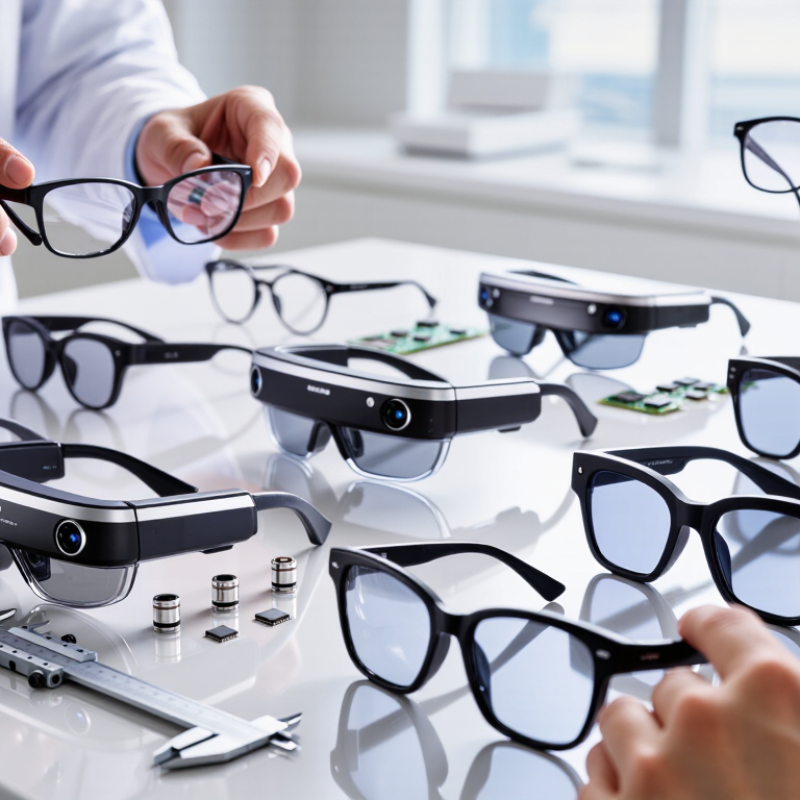
China Top Smart AI Glasses Manufacturers for Global Buyers

What Defines Smart AI Glasses and Their Core Functions

Smart AI glasses combine a wearable frame with microphones, speakers, cameras, and sometimes a small display. Their core functions include hands-free calls, voice-based assistance, photo capture, audio playback, and live information prompts. Some models can summarize spoken content or translate conversations, but performance depends on microphones, connectivity, and software. The glasses should feel like ordinary eyewear, not a tiny computer demanding constant attention.

Counterpoint Research reported that global smart-glasses shipments rose 210% year on year in the first half of 2025. That sharp increase signals growing interest, but shipments alone do not prove daily usefulness. For buyers, assess battery life, camera clarity, audio leakage, comfort, and compatibility with common phones. A frame that pinches after an hour is a real failure. Features also vary widely, and “AI” may describe cloud-based services rather than processing inside the glasses. The category is still messy; product descriptions can make similar functions sound more capable than they are.

Tips: Test voice pickup beside a busy road, check how controls work with gloves, and ask whether key features need a phone connection. Verify standby and active-use battery figures separately. A clear specification sheet helps, though it cannot replace wearing the frame.

How China’s Smart Glasses Manufacturing Ecosystem Is Organized

China’s smart-glasses ecosystem is organized less like one factory and more like a connected chain. Optical suppliers shape lenses and coatings; component firms provide cameras, microphones, displays, and compact processors. Contract manufacturers then integrate these parts, calibrate devices, and test fit, battery life, and heat. The handoffs matter. A tiny alignment error can blur an image or weaken a frame.

The broader electronics base helps explain this structure. China’s Ministry of Industry and Information Technology reported that value added in the country’s electronic information manufacturing sector grew 11.8% in 2024. IDC also reported 286.2 million smartphone shipments in China that year, up 5.6%. These figures do not measure smart glasses directly, but they indicate a deep pool of component and assembly expertise. Suppliers can adapt existing production skills, while buyers still need to verify which parts are genuinely developed for glasses.

Integration remains uneven. Some factories excel at frames and finishing; others handle electronics integration or testing. This can make supplier coordination harder than a catalog suggests. Ask for sample units, component specifications, and test records. Check the details. Manufacturing capacity alone does not guarantee optical comfort, stable connectivity, or consistent quality across production batches.

China Top Smart AI Glasses Manufacturers for Global Buyers – How China’s Smart Glasses Manufacturing Ecosystem Is Organized

Ecosystem Layer Typical Role and Deliverables Common Technologies or Processes What Global Buyers Should Verify
Product design and integration Turns a product brief into frame architecture, component choices, prototypes, and a production-ready design. Industrial design, mechanical engineering, optical integration, thermal design, and design-for-manufacturing reviews. Confirm design ownership, revision control, prototype schedule, tooling responsibility, and change-approval procedures.
Optics and display modules Provides visual output for display-enabled glasses; some products instead use audio and camera functions without an in-lens display. Microdisplays, lenses, optical engines, and waveguide or reflective-combiner designs, depending on the product architecture. Evaluate field of view, eye-box, brightness, image uniformity, optical alignment, prescription-lens compatibility, and outdoor readability.
Electronic components Supplies the sensing, processing, connectivity, power, and audio functions used by the glasses. Processors, memory, cameras, microphones, speakers, inertial sensors, wireless radios, batteries, and charging circuitry. Check component availability, approved substitutions, firmware support, battery protection, wireless performance, and lifecycle plans.
Frames and precision parts Manufactures the wearable structure and houses optical and electronic assemblies while balancing fit, weight, and durability. Injection molding, CNC machining, metal forming, surface finishing, lens fitting, and precision assembly. Review material specifications, dimensional tolerances, finish consistency, hinge durability, comfort testing, and repairability.
AI and software integration Connects device firmware, companion applications, cloud services, and AI features such as voice interaction or image understanding. Embedded software, mobile-app integration, speech processing, camera pipelines, APIs, and over-the-air updates. Clarify supported languages, data flows, privacy controls, cloud dependencies, security updates, API access, and software maintenance terms.
Contract manufacturing and assembly Combines sourced components and finished parts into assembled, configured, and packaged products. SMT for circuit boards, optical alignment, screw or adhesive assembly, firmware loading, and production-line traceability. Audit factory controls, capacity planning, subcontractor use, worker practices, traceability, yield reporting, and quality procedures.
Testing and compliance Checks product performance, safety, reliability, and readiness for the markets where it will be sold. Functional testing, optical measurement, drop and temperature testing, battery evaluation, and radio or EMC testing. Identify applicable destination-market requirements and obtain test reports for the exact hardware and software configuration being purchased.
Packaging, logistics, and after-sales Prepares products for export and supports distribution, returns, repairs, and spare-part supply. Export packaging, shipping documentation, regional labeling, replacement parts, repair workflows, and warranty handling. Agree on Incoterms, lead times, packaging specifications, warranty scope, return procedures, and availability of replacement components.
Buyer qualification approach Maps the product brief to the right combination of design, component, software, and manufacturing partners. Request-for-quotation reviews, sample evaluation, factory audits, pilot builds, and documented acceptance criteria. Compare complete landed cost and verified capabilities—not just quoted unit price—and confirm ownership of tooling, firmware, and product documentation.

Leading Chinese Manufacturers and Their Product Specialties

Chinese smart-AI-glasses manufacturers tend to specialize rather than build every component in-house. Some focus on optical modules, including waveguides and compact display engines. Others concentrate on camera-and-audio frames, voice interaction, or lightweight designs for daily wear. Counterpoint Research reported that global smart-glasses shipments grew 210% year over year in the first half of 2024. That matters. Buyers should still distinguish shipment growth from proven long-term demand.

For global buyers, optical specialists may suit products needing discreet in-lens displays, while audio-focused factories can prioritize open-ear speakers, microphones, and battery life. AI-oriented manufacturers often integrate cameras, onboard processing, and mobile-app connections. Industrial suppliers, by contrast, may emphasize durable frames, replaceable parts, and clear voice pickup in noisy workspaces. Ask for measured details: frame weight, operating time during continuous use, lens options, and microphone performance. A glossy prototype proves little.

Capabilities vary widely between factories. Some offer design, tooling, assembly, and testing under one roof; others rely on outside component vendors. That can affect quality control. Request sample units, test reports, and a written component list before comparing quotes. One weak point deserves attention: AI features can sound impressive, yet comfort and battery endurance may disappoint during a full workday. Independent tests help expose that gap.

Key Criteria for Comparing Manufacturers and Models

For global buyers, compare manufacturers by production consistency, component traceability, and after-sales support—not AI claims alone. Counterpoint Research reported that worldwide smart-glasses shipments grew 210% year over year in the first half of 2024. That signals momentum, not product reliability. Ask suppliers for pilot-run defect rates, warranty terms, and evidence that production units match approved samples.

Compare models in real conditions. Check total weight, nose-pad pressure, lens options, microphone clarity in a busy room, and battery life during continuous audio or camera use. Request measured figures, not “all-day” promises. Test app setup and voice-response delay on the phones your customers use. Also ask how images and voice recordings are handled, and what controls users have. No specification sheet tells the whole story.

Tips: Order several samples. Wear them for an hour, record speech beside a fan, and time a full charge cycle. Small fit differences matter. Some checks may feel overly cautious, but replacing a poor batch costs more.

How Global Buyers Evaluate Sourcing, Compliance, and Support

Global buyers should assess more than appearance when sourcing smart AI glasses. Ask manufacturers for a clear bill of materials, production capacity, and written quality-control steps. Request sample test records for battery performance, audio clarity, camera function, and frame durability. Check whether production units match the approved sample. Paperwork matters.

Compliance needs vary by destination and product configuration. Buyers should confirm applicable requirements for wireless functions, batteries, optical components, labeling, and data handling in each target market. Request current test documentation and identify who updates it when components change. A polished sample can still hide inconsistent production. Small pilot orders help reveal fit, charging, and finish issues before larger commitments. They also take time.

Support after delivery deserves equal attention. Confirm warranty terms, spare-part availability, repair procedures, and firmware update responsibilities in writing. Ask how quickly technical questions are answered, and whether support is available in the buyer’s working language. Response speed matters. A supplier may promise fast service, but buyers should test that promise during sampling. Even a well-prepared checklist can miss a detail; review findings with a qualified compliance professional before shipment.

Article Source: